When people think about building, their focus is usually on the visible parts. The design, the elevation, the finishes, the beauty of the structure.
But here is the truth many ignore.
A building is only as strong as the soil it stands on.
You can have the best architectural design.
You can use high quality materials.
You can hire the most skilled professionals.
If the soil beneath your building is not properly understood, everything above it is at risk.
What is Soil Investigation?
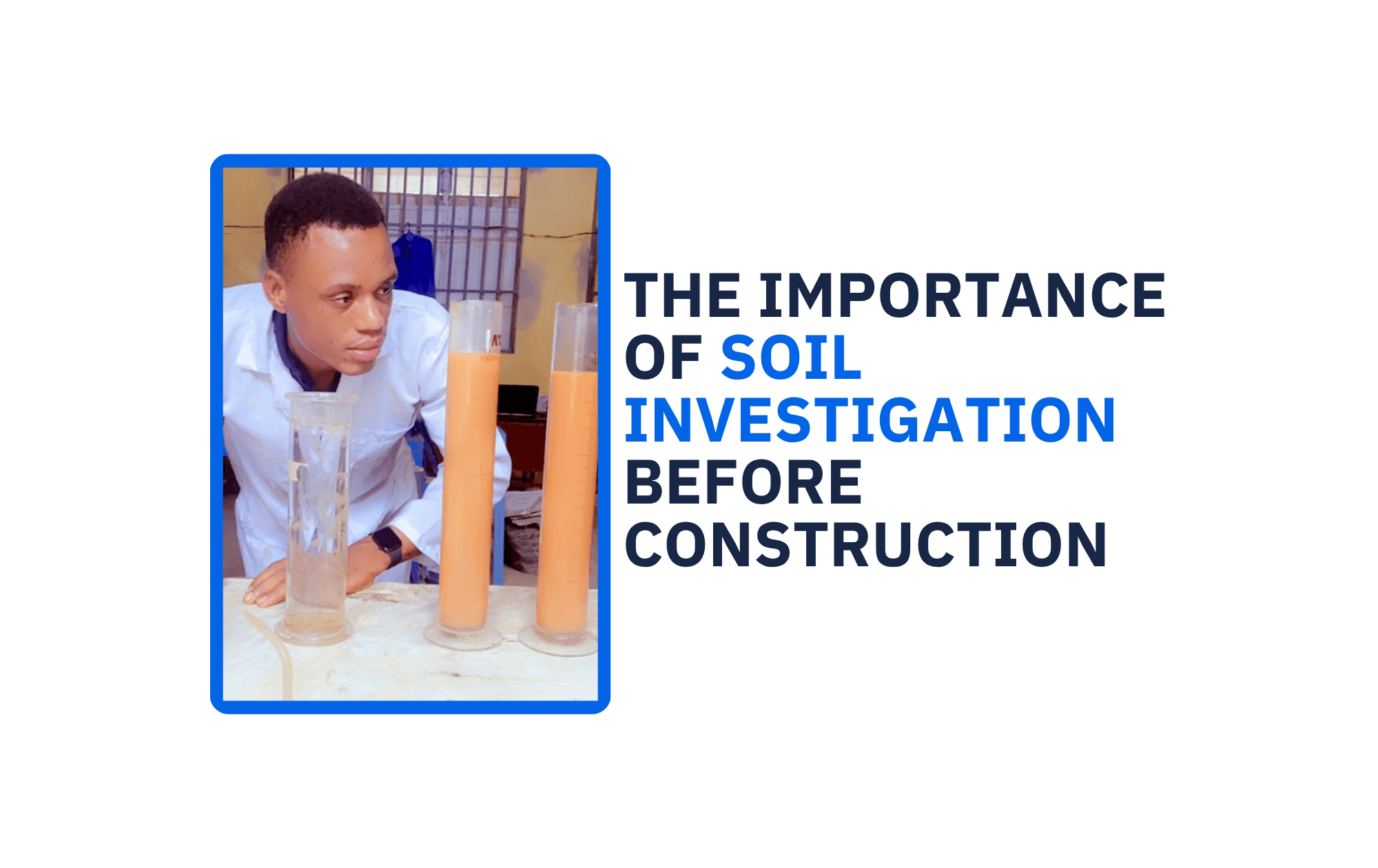
Soil investigation is the process of studying the physical and engineering properties of the ground before construction begins.
It helps determine:
-
The type of soil on site
-
Its strength and load bearing capacity
-
Moisture content and drainage behavior
-
Settlement characteristics
In simple terms, it answers one critical question:
Can this ground safely support your building?
Why It Matters More Than You Think
1. The Foundation Depends on It
Your foundation is designed based on soil conditions.
Without proper soil investigation, your foundation design is based on assumptions.
And in construction, assumptions are dangerous.
Soil investigation helps engineers determine:
-
The right type of foundation
-
The appropriate depth
-
The required reinforcement
Because what works on one site may fail completely on another.
2. It Prevents Structural Failure
Many building failures do not start from the top.
They start from below.
Weak or unsuitable soil can lead to:
-
Differential settlement
-
Cracks in walls and slabs
-
Tilting structures
-
In extreme cases, total collapse
These issues may not appear immediately.
But over time, they become serious structural threats.
Soil investigation helps detect these risks early.
3. It Saves You From Costly Mistakes
Skipping soil investigation may seem like a way to reduce initial costs.
But the long term consequences can be far more expensive.
Without proper investigation, you may face:
-
Unexpected foundation redesign
-
Structural repairs
-
Project delays
-
Increased construction cost
In some cases, you may even need to abandon the project entirely.
Soil investigation helps you plan properly from the beginning and avoid expensive surprises.
4. It Helps You Choose the Right Location
Not all land is suitable for building.
Some soils may require special treatment.
Some may need deep foundations.
Some may not be suitable at all without significant cost.
Soil investigation gives you clarity before you commit.
It helps you make informed decisions about whether to build, redesign, or reconsider the site.
5. It Improves Long Term Performance
A building is not just meant to stand today.
It must perform well over time.
Proper soil investigation ensures that:
-
Settlement is controlled
-
Drainage is properly managed
-
The structure remains stable for years
Because durability starts from the ground up.
The Hidden Risks Beneath the Surface
What you see on the surface can be misleading.
A piece of land may look solid and stable.
But beneath it could be:
-
Loose or compressible soil
-
Expansive clay that swells and shrinks
-
Waterlogged layers
-
Organic or weak materials
Without investigation, these hidden conditions remain unknown.
And unknown risks are the most dangerous.
The Smart Way to Build
Modern construction is not just about building fast.
It is about building right.
Professionals who take soil investigation seriously are not just trying to follow procedure.
They are protecting:
-
Lives
-
Investments
-
Their professional reputation
Because once construction begins, correcting foundation problems becomes difficult and expensive.
Final Thought
Before you lay the first block, dig the first trench, or pour the first concrete, you must understand the ground you are building on.
Soil investigation is not an extra step.
It is not something to skip to save money.
It is the foundation of every successful project.
Do not just ask:
How will the building look?
Ask the more important question:
Is the ground ready to carry it?