In the world of construction, people celebrate what they can see. The sleek finishes, the grand facades, the aesthetics that turn heads.
But the real truth?
The most important part of any building is what you cannot see.
Behind every solid structure is a silent assurance.
An assurance that the building will not crack under pressure, fail unexpectedly, or put lives at risk.
That assurance comes from one critical process:
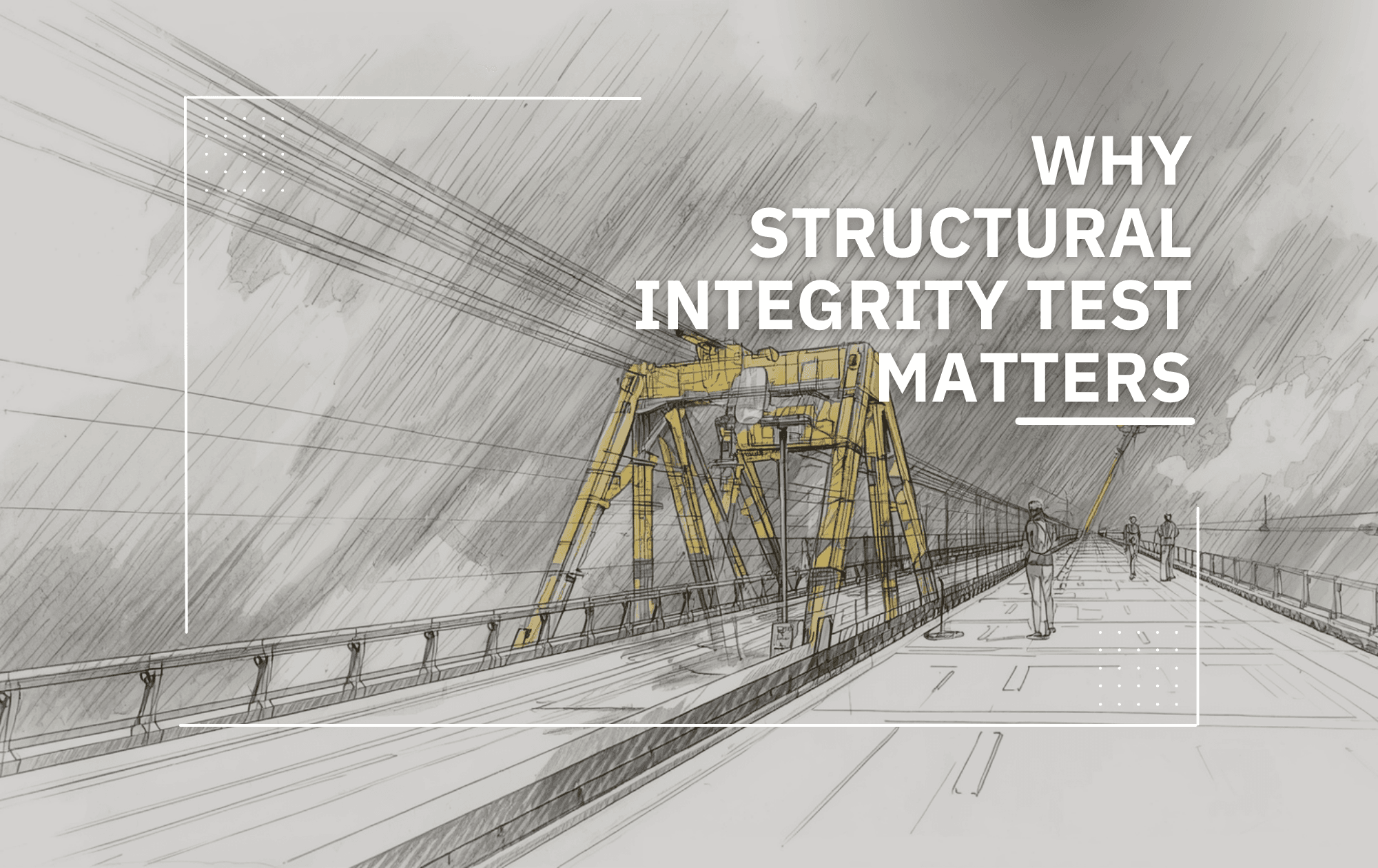
Structural Integrity Testing
What is Structural Integrity Testing?
Structural integrity testing is the process of evaluating a building’s strength, stability, and ability to perform safely under expected loads and conditions.
It answers one simple but powerful question:
Will this structure hold today, tomorrow, and years from now?
It goes beyond assumptions.
It replaces guesswork with proof.
Why It Matters More Than You Think
1. Because Failure is Not an Option
When a building fails, it does not fail quietly.
It collapses.
It destroys investments.
It endangers lives.
Across many construction environments, structural failures are not always caused by lack of effort.
They are often caused by lack of proper testing and verification.
A design may look perfect on paper.
Construction may appear flawless on the surface.
But without testing, you are building on uncertainty.
2. It Protects Lives First
Every beam, column, slab, and foundation carries responsibility.
Structural integrity testing ensures that:
-
Loads are properly distributed
-
Materials are performing as expected
-
Hidden weaknesses are detected early
Because in construction, safety is not a feature.
It is the foundation.
3. It Saves You Money
Many people avoid testing to cut costs.
But here is the reality.
Skipping testing is one of the most expensive mistakes you can make.
Why?
Because undetected issues lead to:
-
Costly repairs
-
Structural retrofitting
-
Project delays
-
Total rebuilds in extreme cases
Testing helps you catch problems before they become disasters.
4. It Validates Design and Workmanship
Design is theory.
Construction is execution.
Structural integrity testing connects both.
It confirms that:
-
The design has been properly implemented
-
Materials meet required standards
-
Workmanship aligns with engineering expectations
Without it, you are simply hoping everything was done right.
5. It Builds Trust and Professional Credibility
Clients today are becoming more informed.
They do not just want buildings.
They want confidence.
When you incorporate structural integrity testing into your projects, you are not just delivering a structure.
You are delivering:
-
Assurance
-
Professionalism
-
Long term reliability
And that is what sets true professionals apart.
The Silent Threat
Some of the most dangerous structural issues are invisible at first:
-
Internal cracks within concrete
-
Weak reinforcement placement
-
Substandard materials
-
Foundation settlement issues
These do not always show immediately.
But over time, they become serious problems.
Structural integrity testing exposes these hidden threats early when they are still manageable.
The Future of Construction
The construction industry is evolving.
It is no longer enough to design and build.
You must test. You must validate. You must prove.
Professionals who understand this are not just builders.
They are trusted experts.
Final Thought
Anyone can design a building.
Many can construct one.
But only true professionals ensure that what they build is safe, reliable, and built to last.
Structural integrity testing is not an extra step.
It is not optional.
It is the difference between confidence and risk.
Between durability and failure.
Between a structure that stands and one that does not.
If you are building, designing, or planning a project, do not just ask:
How will it look?
Ask the more important question:
Will it stand?